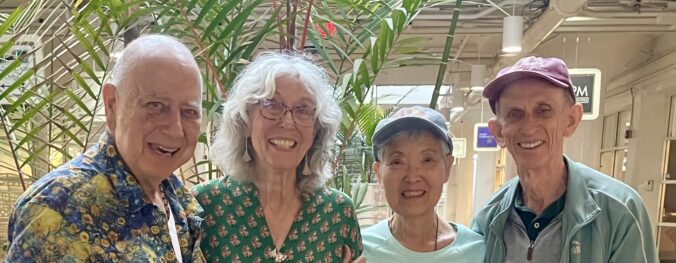
I just returned from a pilgrimage to Hawaii, where I went, primarily, to see old friends. There is something extraordinary about seeing friends as we all get older. Our faces have aged. Our hair is grey or white or missing altogether. Our bodies are letting go, here and there.
One friend I was quite grateful to see on this trip rarely leaves his apartment now. He has bouts of dizziness—or even just threats of dizziness—and so he cannot drive. His laugh hasn’t changed at all.
Another friend, my former husband, is going to be ninety in September. I missed his birthday the first year after we got married, but I won’t miss this one, not if I’m here myself. He still drives, but only during the day. So, instead of taking me to dinner, as he has done so many times, he now takes me to a lovely lunch.
One woman I see in Hawaii is someone I met at a weekend workshop fifty-four years ago. She and her second husband are, they tell me, on their final pet—a beautiful bird they bring with them when we get together, carrying him in his cage. They cannot get another pet, they tell me, because what would happen if they predeceased that pet? Who would take on caring for the animal?
On this trip—and on most of my trips to Hawaii—I stayed with another old friend, a woman I met at a weekend workshop fifty-three years ago and with whom I have maintained an ongoing friendship for most of that time.
These people are all so important to me. Of course, some of our friends have died and some have succumbed to that inexplicable loss of mental acuity that means we recognize them, but they cannot access their memories of us. Last year, when I learned that one very dear friend had been diagnosed with Alzheimer’s, I wept. I felt that at some point soon, I would be the only one holding the considerable treasure of our shared experiences.
Recently, though, I have revised this perspective. My maternal grandmother had profound Alzheimer’s for the last, perhaps, sixteen years of her life. But Grandma Wells has now passed on, and I sometimes receive “messages” from her—subtle communications that I hear in my mind—and these let me know that she is fully herself once again. In other words, Grandma Wells is back and—in fact—better than ever! Don’t ask me how any of this works.
So, I trust that whatever it is that happens with my friends who have Alzheimer’s, it will not last forever.
Seeing these people is precious to me. As the friend I stayed with said one day while I was there, “It is almost unbelievable that we have known each this long.” It’s true. Our friendship covers so many life experiences for us both—various romantic and marital relationships, different homes, diverse life roles. We’ve been in ashrams together a number of times—at one point she was the Guru’s seamstress, and at another she managed the IT Department; at one point, I was head of PR, and at another I was a Hindu nun.
This time, I told my friends that it might be my final trip to the islands, but that was just me being careful. I will go back again if I can. In the first place, Hawaii is a jewel, a place of exquisite beauty. It is more “home” to me than any other place I have ever lived. So many vital aspects of my life began or occurred in Hawaii: my only marriage, the beginning of my writing and editing career, the introduction to my spiritual path…
Also, there is an ease to life in Hawaii that has much to do with Hawaiian culture—the word for “hello” means “I love you” and it also means “in the presence of God”—and something to do with the islands’ beneficent tropical weather. (Years later, I lived in upstate New York with the understanding that for at least five months each year, anytime I stepped outside, I could conceivably die from exposure to the elements. It was there that I learned the terms “layering” and “wind chill factor.”)
Yet my most recent visit to Hawaii was not the norm. I arrived with the second wave of a tropical storm, and for the twelve days of my visit, there was a lot of rain, along with threats of a dam breaking. I have to add that I was not seriously inconvenienced by any of this—more than five thousand beleaguered people had earlier evacuated their homes because of flooding—but the resulting “brown tides” did keep me out of the water and the rains often kept me away from the beaches.
That was when I realized that I had come to Hawaii not for the beach walks and swimming but for the chance to say “aloha” to dear friends.
It was a lovely trip—and even though I contracted a messy cold on the plane home, if I can, I will be returning to the islands again.

Peggy, your writing, your perspective, your humanity, your spirituality, your love for others are gifts beyond compare for those of us who are close to you. I am so disappointed to have missed seeing you this time. You saw my potential and hired me right out of college. You mentored me as we worked on the newspaper. I consider ours a deep spiritual bond that has supported and blessed me in all aspects of life, and I am deeply grateful to you. Peggy, the way you’ve embraced me as a new Alzheimer’s patient is a powerful bond that will see me to the end. Mahalo., dear sister.
Absolutely lovely, Margaret.
Aloha from Whidbey.
Welcome back to Oakland, Margaret, another of your homes—the second? third? In any case, you were missed. Thank you for sharing these thoughts on friendship, aging, life. You manage capture many of my own random thoughts and put them into simple, and yet profound and inspiring, words on a page that I can relate to.